
Reporters Risk their Lives in the Middle East
When the Iran-backed Iraqi terrorist militia Kata’ib Hezbollah kidnapped American journalist Shelly Kittleson in Baghdad last March, it exposed critical threats facing press freedom across the Middle East. As geopolitical tensions rise between Iran, Israel, and the United States, journalism has become an increasingly dangerous task in the region. On July 30, the Atlantic Council hosted a panel titled "Reporters at Risk - The State of Press Freedom in Iraq,” where correspondents discussed the dangers that journalists face in the field and explored potential safeguards for free press in the Middle East conflict. Ultimately, the discussion uncovered a truth: objective journalism cannot thrive where authoritarian influence and non-state groups dictate the flow of information.
A central theme of the panel was the lack of protection for journalists working in zones involved in the conflict. Mustafa Salin, a Baghdad-based reporter from the Washington Post and panelist, argued that true press freedom requires structural backing, saying, “Press freedom is guaranteed through an institution.” Salim and his fellow panelists argued that without judicial accountability, militia groups like Kata’ib Hezbollah operate with impunity. Currently, Iraq lacks robust legal frameworks designed to safeguard reporters. The absence of solid legal institutions leaves reporters vulnerable to targeted violence without legal recourse or state protection. An institution that secures the rights and the protection of journalists, both local and foreign, would enhance the freedom of press. This institution would allow reporters to access information and would also guarantee protection and security from militant groups like Hezbollah.
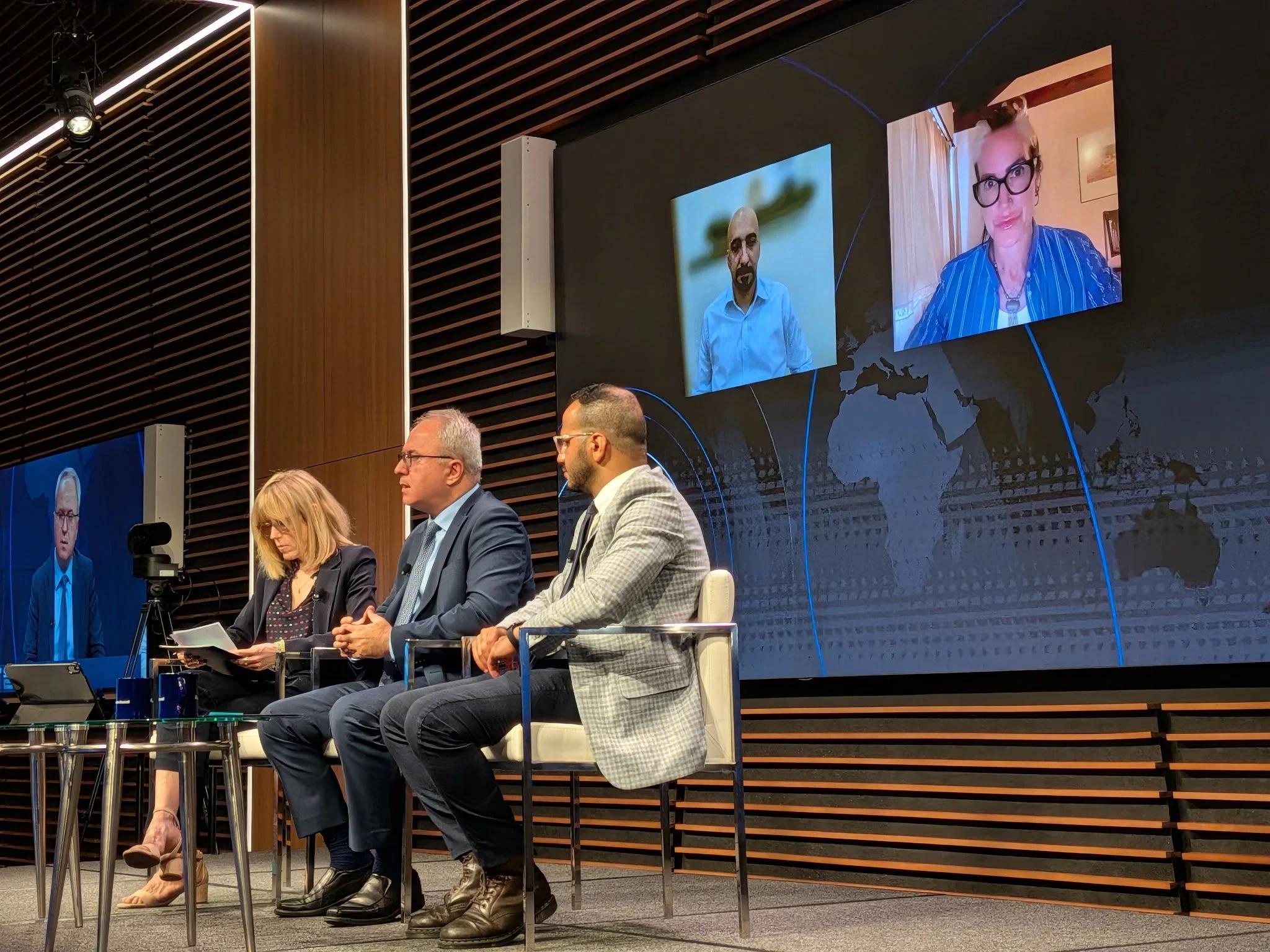
From left to right — Arwa Damon, Sarhang Hamasaeed, and Mustafa Salim.
In countries where journalists are threatened and often persecuted for their job, this institution looks more like a special intelligence agency. For instance, the UNP (Unidad Nacional de Proteccion or National Unity of Protection) in Colombia focuses on the protection of reporters in high-risk situations concerning organized crime, drug trafficking, and political corruption. Other examples of similar special intelligence organizations are the ones in countries such as South Korea with the NIS or Taiwan with the NSB. These intelligence agencies specialize in the protection of reporters at risk for uncovering illegal activity. The use of bodyguards, armored transport, and panic alarms connected directly to emergency response centers is a better alternative for these countries where militant groups outside of the law are a threat to the press. At the end of the day, one of the main roles of the government is to guarantee the protection of citizens—this includes the cases of journalists outside and inside the country—so they must have the right to access the benefits of intelligence protection.
Furthermore, a reporter’s security often depends on whether one is local or foreign. For all cases of foreign journalists, embassies are responsible to protect the reporters with diplomatic support and security logistics—such was the case of Shelly Kittleson and the American embassy. For instance, the Washington Post’s staff fall under the protective purview of the U.S. embassy in Iraq. This safety net, however, rarely extends to local, independent, or freelance journalists.
At the same time, institutional backing comes with its own trade-offs. Panelist Sarhang Hamasaeed, a peacebuilding practitioner and Middle East analyst, noted that freedom of expression in Iraq is influenced by the political alignments of media outlets. In conflict zones, media security and political bias are linked: outlets with clear political affiliations may secure protection from allied factions, but independent voices seeking truth are left exposed to threats from all sides. For this reason, security and media go hand-in-hand when it comes to journalism in the Middle East.
The issue of press freedom in Iraq is inseparable from Iranian state influence. Tehran regularly funds and directs proxy groups like Kata’ib Hezbollah to intimidate opposition voices, suppress independent reporting, and control public narratives. It is no secret that Iran’s domestic record mirrors its external strategy: using fear and violence to silence dissent by the means of threatening the press in order to enforce control and stay in power. For instance, the Woman, Life, Freedom movement in 2022 caused by the death of 22-year-old Jina Mahsa Amini in police custody for an alleged violation of mandatory hijab laws, or the more recent hanging of 26-year-old dissident Nasser Bakerzadeh proves the regime uses fear to exert control over its people.
At the end of the day, good journalism cannot exist without freedom of the press, and this freedom begins when journalists are safe to do their jobs. While authoritarian governments can allow some measure of free speech to their own citizens, long-term press freedom in a country like Iraq requires domestic institutions that enforce judicial accountability and protect speech. Freedom of speech will always be at risk when an authoritarian regime is involved. Authoritarians tightly control who gets access to information and use force when their whims are defied; therefore, we are less likely to get good journalism from their countries. The protection of the press is possible through special intelligence dedicated to fight against the threats of terrorist groups, and additionally, these intelligence agencies define one of the foundations of good governance: to ensure justice and liberty, in which freedom of the press plays a significant role. Republican forms of government, like that of the United States, ensure these conditions are better met, compared to authoritarian models where the government chokes the free flow of information.